


Experiences change us. The people we meet throughout life change us. The places we visit also change us. We take all these claims for granted, because they are “general places”, and something that applies to most of us. However, the way in which we are affected by new experiences, and especially people and places that we come into contact with for the first time, or in a different context than before, have the ability to do much more – to encourage us to think, inspire us in further work, and often provide us with a completely different perspective on things that we thought we already knew.
A group of young people who took part in a study visit to Prishtina and Gračanica at the end of April, organized by Civic Initiatives, got the opportunity to experience it. Although short, the study visit gave them a chance to meet a different Kosovo than what they mostly had the opportunity to read, hear and see, both in the mainstream media and in the general public.
“The experiences and stories I encountered further motivated me to be more active in the promotion of dialogue, tolerance and protection of human rights.”
The visit to Pristina began with a visit to the editorial office of the Kosovo 2.0 platform and a conversation with the editor-in-chief, Besa Luca, about the history and work of the platform, the role of the media in building reconciliation and dealing with the past in the region, as well as examples of good practice of inter-ethnic cooperation in the field of media and investigative journalism. The group had the opportunity to see various researches and reports that Kosovo 2.0 has published over the years on the topic of dealing with the past, but also to look at publications and some of the rare physical copies of the Kosovo 2.0 magazine.
The meeting with the publicist, analyst and activist Shkëlzen Gashi focused, first of all, on the conversation about his work on the analysis of history textbooks in the countries of the former Yugoslavia, then his book “Massacres in Kosovo 1998-1999”, as well as his multi-year project “The Other Serbia”. In addition, many interesting and important topics were raised, such as the role of civil society in the reconciliation process, the relationship of the Albanian national minority in Serbia towards Kosovo and vice versa, but also the fate of the transitional justice process today.
“This visit inspired me to work even harder on what we started as young Albanians and Serbs, and to fight even more strongly for our rights.”
At the end of the first day, a visit to the Barabar Center was organized, which is located in the very center of Pristina, in the former Grand Hotel. In addition to the historical importance of the location itself, the Barabar Center plays an important role in the artistic and activist scene, both in Kosovo and in the region. The group was hosted by Kushtrim Koliqi, director of the Integra organization, who presented the work of the Barabar Center and the importance of the availability of space for independent art and artivism. Special attention was also given to the discussion about the importance and role of the “Mirdita, good day” festival in the process of building trust and reconciliation, which has been organized for years in Belgrade and Pristina in cooperation with Integra, the Youth Initiative for Human Rights and Civic Initiatives.
“I knew there was a ‘Brotherhood and Unity’ statue, but I didn’t know the story behind it.”
Although the weather conditions were not the most favorable on the second day of the visit to Prishtina, the group of young people resolutely continued their activities as planned. The first such activity was a walking tour of the city, with special emphasis on the Yugoslav and post-Yugoslav heritage of Pristina, in the company of Korab Krasniqi from the organization ProPeace Kosovo.
The walk started from the National Library, that is, the University of Pristina, including talks about the art installation Informative Hat by Eliza Hoxha and the Temple of Christ the Savior located within the campus. After that, the tour continued to the Monument to the Heroes of the National Liberation Struggle, where there was a discussion about the fate of the monuments that represent the Yugoslav past, as well as the additional symbolism that such “redacted” monuments carry today.
“Describing the monument as a place of collective memory made the biggest impression on me.”
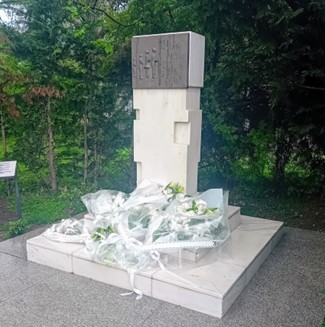
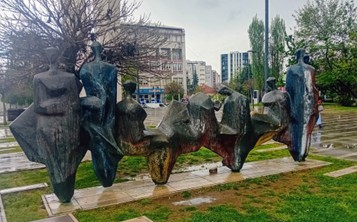
The next monument that the group of young people visited was the monument to the missing called “Those we miss”, one of the few monuments to the victims of the wars of the 90s in the territory of the former Yugoslavia that is not ethnically colored. Created as an initiative of the victims’ association, today it is an expression of the common suffering of all those who still do not know the fate of their family members, but also a place where they leave flowers together every year on the International Day of the Missing in memory of all the missing.
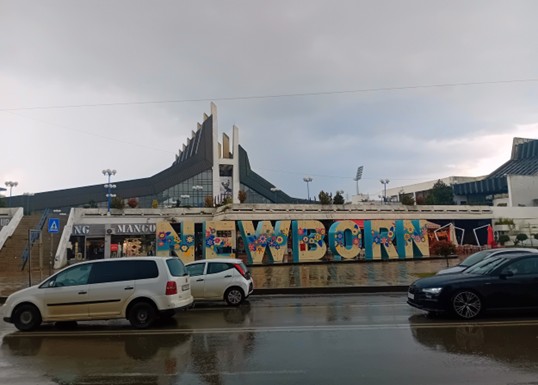
The path led the group of young people to the monument to Ibrahim Rugova, Mother Teresa Square, and the statue of Zahir Pajaziti, as well as to the monument dedicated to the student protests of 1968. The visit to these monuments also encouraged a discussion about monuments that glorify fighters and the dominant masculinity that is usually present in such monuments. The walk, symbolically, ended at the now famous NEWBORN monument, which is located in front of the Youth and Sports Center, once better known as “Boro and Ramiz”. It was the story of the fates of the “real” Bora and Ramiz that rounded off this walking tour, and served as a lesson in fostering togetherness and solidarity, which we desperately need even today.
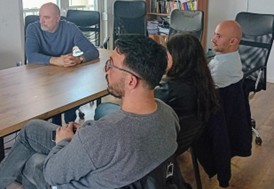
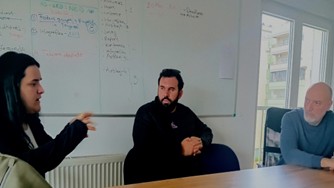
The discussion on important topics for our societies continued during the visit to the Institute for Social Policy of Musina Kokalari, where the young people talked with Visar Ymeri, the executive director of the Institute, primarily on the topic of the future. Given that the expression “dealing with the past” in public discourse in our region is often used only as a phrase, without any essential meaning, the question arose whether today, in 2025, is actually the time to look at the common future of the region, and agree on what we want it to look like. Problems between which it is possible to draw a parallel were also discussed, such as minority rights, as well as social problems such as health care, workers’ rights and “living wage”, as well as possible common solutions for these not so small challenges.
“Honestly, I did not know the exact number of children killed or missing during the years 1998-2000.”
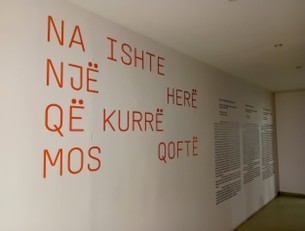
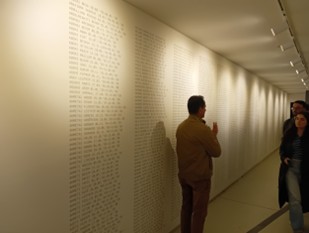
The day ended in an extremely emotional way – with a visit to the exhibition “It happened once, it never happened again” in the Documentation Center of Kosovo, organized by the Fund for Humanitarian Law of Kosovo, and a meeting with the executive director Bekim Blakaj. This exhibition is dedicated to children who were victims of war in the period 1998-2000. killed, or are still missing.
“The displays of the stories of the suffering of children and the personal belongings of the victims reminded me how destructive crime and war are and how important it is to learn from the past so that such events never happen again.”
According to them, the fact that this exhibition contains personal items and stories about children of all ethnic communities left a special impression on the group of young people, that is, that it is not one-sided. Some of them had heard about the exhibition before, but no one expected how much they would be affected by dealing with, first of all, the number of child victims, then the number of children who are still missing, and finally – the stories that Bekim Blakaj shared with them, concerning the process of creating the exhibition and communicating with the families of the victims.
“I was especially inspired by her dedication to documenting war crimes and promoting the protection of human rights.”
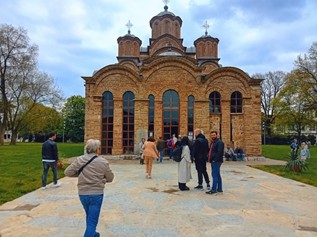
On the last day of the visit, and before returning to Belgrade, the group visited Gracanica and spoke with historian Marijana Tom. Before the actual meeting, the young people had the opportunity to visit the Gračanica monastery. Particularly interesting, in addition to the tour of the monastery itself, was the fact that several parallel events took place in one small space. On the one hand, there were tourists from different parts of the world who came to visit the monastery as part of cultural and religious heritage, take photos, and learn more about its history. A television crew was also present, standing by the entrance to the church, and probably came to take a statement from the priest. And in the church itself, a baptism was taking place.
After the Gračanica monastery, it was time for the last meeting as part of this study visit, namely with the historian Marijana Tom, who has been living and working in Gračanica for many years. In a relaxed conversation with young people, Marijana told about her experiences and achievements of working on dealing with the past and documenting war crimes, but also the fact that continuous work on these topics and advocating for transitional justice in the region, without great results in terms of changing the dominant narratives and achieving truth and justice, can unfortunately also have negative consequences, in the form of burnout.
“One of the significant parts of the study visit for me was the meeting with Marijana [Tom] in Gračanica. Her rich experience and commitment to work on dealing with the past gave me a deeper understanding of the importance of truth and justice in the reconciliation process.”
After that, they discussed the situation in Gračanica itself today, but also the topics Marijana deals with today, namely the rights of minority communities in Kosovo. Young people had the opportunity to hear a lot of new information, especially regarding the rights of the Roma national minority in Kosovo.
This study visit, judging by the impressions of the participants, succeeded in its intention, which is to educate, broaden horizons and make people think about topics that are unfortunately not present enough in the public eye. Instead of a conclusion, it is best to quote one of the participants of the visit:
“Although I am very sensitive when it comes to the process of building peace and dealing with the past, every time these topics are discussed, one is affected in many ways. If I were to put it in a stylized way – the victim has no color, no age, let alone any other subtle identity determinants.”
*All quotes used in the text were taken, in their original form, from the evaluation form that the participants filled out after the study visit*
The study visit to Kosovo was organized as part of the project “Confronting the past – new generations, new perspectives” implemented by Civic Initiatives as part of the project “Support of the European Union to building trust in the Western Balkans” funded by the EU and implemented by UNDP, and implemented in Bosnia and Herzegovina (BiH), Kosovo*, Montenegro, North Macedonia and Serbia.