


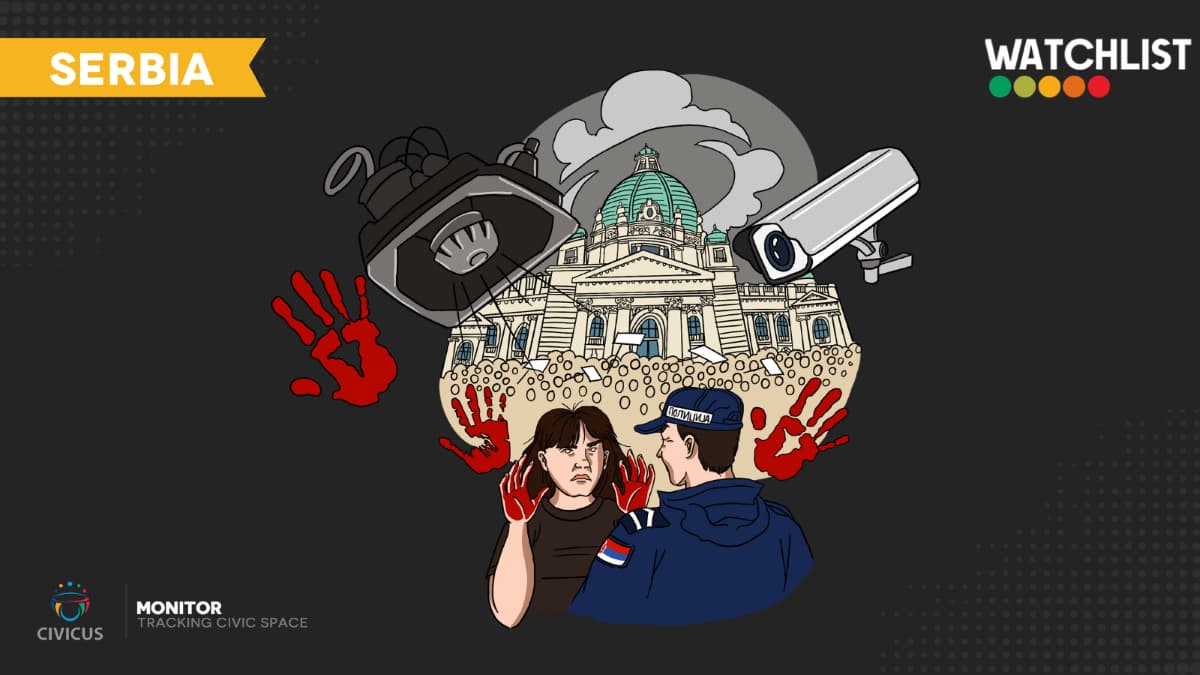
July 30, 2025.
- Across the country, civil disobedience is met with brutality and arrests
- The state provides support and legal protection to batterers
- Worrying increase in wiretapping and intimidation of activists
Johannesburg, July 30, 2025 – CIVICUS Monitor has once again put Serbia on its watch list of countries where there is a sharp deterioration in civil liberties. The decision follows an intensified crackdown on massive student protests against government corruption that have rocked the country since November 2024, following the deadly collapse of a train station canopy.
Serbia’s continued presence on the watch list reflects increasingly serious threats to the rights to peaceful assembly, freedom of expression and association, as authorities use violence, surveillance and politically motivated prosecutions to stifle critical voices. CIVICUS Monitor currently rates Serbia as a country “with obstructed civic space”, which means that civil society is functioning, but faces serious legal and practical obstacles. Along with Serbia, the latest watch list also includes Kenya, El Salvador, Indonesia, Turkey and the United States of America.
“While the protesters persist in their demands for accountability and systemic change, the authorities are trying to quell the movement with a new wave of state violence,” said Ine Van Severen, director of the civic space research program at CIVICUS, “Serbian authorities are actively punishing citizens who publicly make demands of their leaders.”
Mass protests met with violence and intimidation
To quell student protests, Serbian authorities unleashed a wave of violence by police and groups affiliated with the ruling party, along with mass arrests, surveillance and intimidation.
The police repeatedly threw tear gas and beat the protesters, which constitutes an excessive use of force. More than 400 arrests were recorded in the first week of July alone. Reliable reports indicate cases of severe injuries and abuse during detention.
After a large protest on June 28, the police violently dispersed the crowd and arrested 77 people, some of whom were not given medical help. In response, protesters began actions of civil disobedience, with barricades erected and spontaneous protests across the country.
In March, pro-government counter-demonstrators, with the support of city authorities and police protection, set up camps around key institutions in Belgrade. These camps have become hotbeds of violence, with frequent clashes and attacks on journalists.
Protesters further accuse the police of illegally using sound weapons during the March 15 protest, which was attended by about 300,000 people. The silence in honor of the victims’ mail was broken by a loud, disorienting sound that caused panic and a stampede. Civil society organizations requested an investigation, which was supported by requests from six UN special rapporteurs and an interim measure by the European Court of Human Rights.
The police first denied involvement, and then admitted the presence of a specialized acoustic device for breaking up demonstrations (Long Range Acoustic Device, LRAD), although they continued to deny their use.
High government officials supported and tried to justify the violence against the protesters. In July, President Aleksandar Vučić pardoned four men associated with his party who brutally beat a student in Novi Sad—an attack that led to the prime minister’s resignation in January. Vučić also announced the pardon of a woman accused of attempted murder, because she drove her car into a group of protesters, stating that more pardons will follow.
Officials have also put pressure on prosecutors and judges, accusing them of favoring protesters and undermining the independence of the judiciary. Ahead of larger protests, state services have stepped up surveillance and criminalization of activists. In March, they recorded a private meeting of representatives of the opposition and civil society without a warrant, and then the recordings were published in the pro-government media. The police then arrested six participants of the meeting and accused them of attempting to subvert the constitutional order, with the prosecution requesting a maximum sentence of five years, before they were transferred to house arrest. Another six people, currently abroad, are awaiting trial in absentia.
Just before the June 28 protest, new wiretapped conversations were rebroadcast, and authorities arrested eight student activists outside university buildings. Since the court rejected the request for custody, the prosecution filed an appeal.
“The conduct of the security forces is deeply alarming. They protect thugs who attack protesters, use violence themselves, and wiretap activists without any legal basis or oversight,” said Uroš Jovanović, public policy program manager at Civic Initiatives. “Violation of the right to freedom of assembly and expression does not serve the public interest, but only the interests of those who want to retain power.”
Intimidation and retaliation
Many citizens who support the protests have faced smear campaigns, dismissals and threats. Foreign nationals have been expelled or threatened with deportation for expressing support for protesters, while transport companies have suspended services without explanation ahead of large rallies.
In one case, severe police harassment of a private transporter transporting protesters — including fines, sabotage, threats and the forcible arrest of his son — led him to attempt self-immolation outside the ruling party’s premises.
“We are witnessing the dismantling of civil liberties in Serbia in real time,” said Simona Mladenovska, from the policy and advocacy program at the Balkan Civil Society Development Network (BCSDN). “We are again raising the alarm and calling on the international community – especially the EU – to move from words to action. We welcome the growing awareness, but the response must match the scale of the repression.”
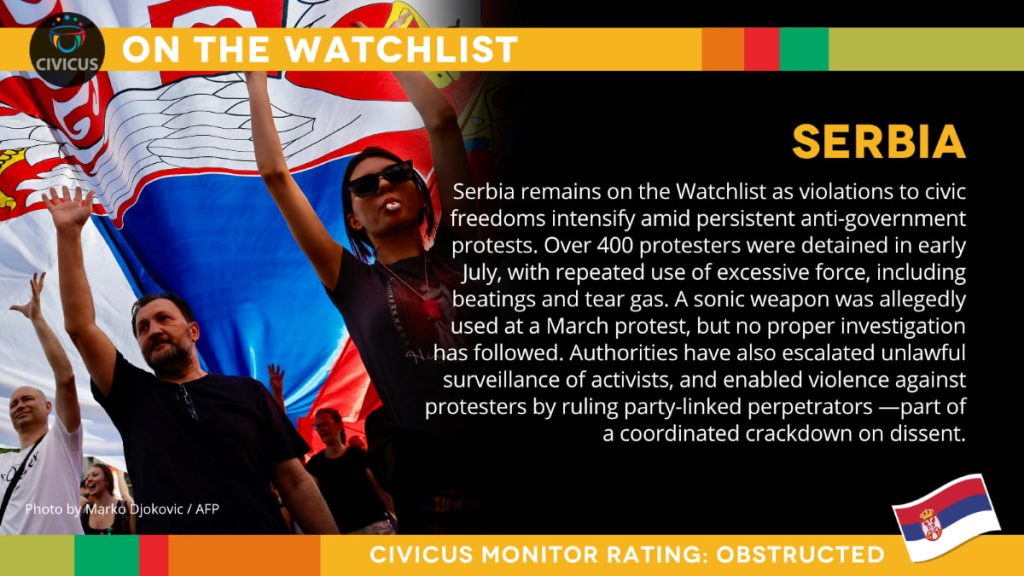
About the CIVICUS Monitor Watchlist:
The new watchlist was released by CIVICUS Monitor, an online platform that tracks the latest developments in civil liberties, including freedom of expression, association and peaceful assembly, in 198 countries and territories.
Civic space in countries is categorized into five levels: “closed”, “repressed”, “obstructed”, “narrowed” and “open”, based on a methodology that combines multiple sources of data on freedom of association, peaceful assembly and expression.
The score “obstructed” indicates a medium level of restriction. It describes an environment in which the authorities disrupt the work of civil society organizations, protesters are subjected to excessive force, and independent media and editorial freedom are severely restricted.
Over twenty organizations collaborate to provide reliable evidence and stimulate action to improve civic space on all continents.
Illustrations: CIVICUS Monitor