Ahead of today’s protest in Belgrade, we are witnessing a worrying escalation of repressive measures aimed at discouraging citizens from participating in peaceful gatherings and expressing dissatisfaction. From the arrest of citizens to the banning of foreign journalists from entering Serbia – these actions represent a serious violation of basic rights and abuse of institutions for political purposes.
Political activists and students were arrested yesterday after pro-government tabloids timely published their wiretapped conversations, triggering a targeting campaign. Immediately afterwards, the president and state officials prejudged the blame, labeling them as terrorists, thereby exerting political pressure on the judiciary and instrumentalizing institutions for dealing with dissidents.
At the same time, the President of the National Assembly highlighted the allegation that the University of Belgrade has contact with the military union. Although there is nothing illegal in the communication of various actors in society, the Higher Public Prosecutor’s Office expressly ordered the police to investigate “whether and who among the members of the University of Belgrade were in contact with the Military Union”.
At the same time, the suppression of media freedom intensified. Journalist teams were banned from entering Serbia under the pretext of “security risk”, a KTV journalist was detained again yesterday, while a fake protest was organized in front of the N1 newsroom the day before, in an attempt to further discredit and intimidate this media.
In the last two days, we have also noted the barricading of the city center with the delivery of a huge number of tractors, reports of the employment of beaters in Belgrade, stopping people at the border when entering the country and widespread sabotage of the transport of protest participants, along with today’s cancellation of city and suburban transport in Belgrade. All this points to a systematic attempt by the government to suppress any kind of resistance through repression and manipulation of public opinion.
Such actions are part of a wider strategy of intimidation, provocation of violence and sending the message that any individual can be monitored, targeted and arrested for any word spoken in any context. Institutions are obliged to act in accordance with the law and protect the basic rights of citizens, instead of participating in their violation.
We call on the police and the prosecutor’s office not to succumb to political pressure and to act professionally and impartially during today’s protest, in accordance with their legal obligations.
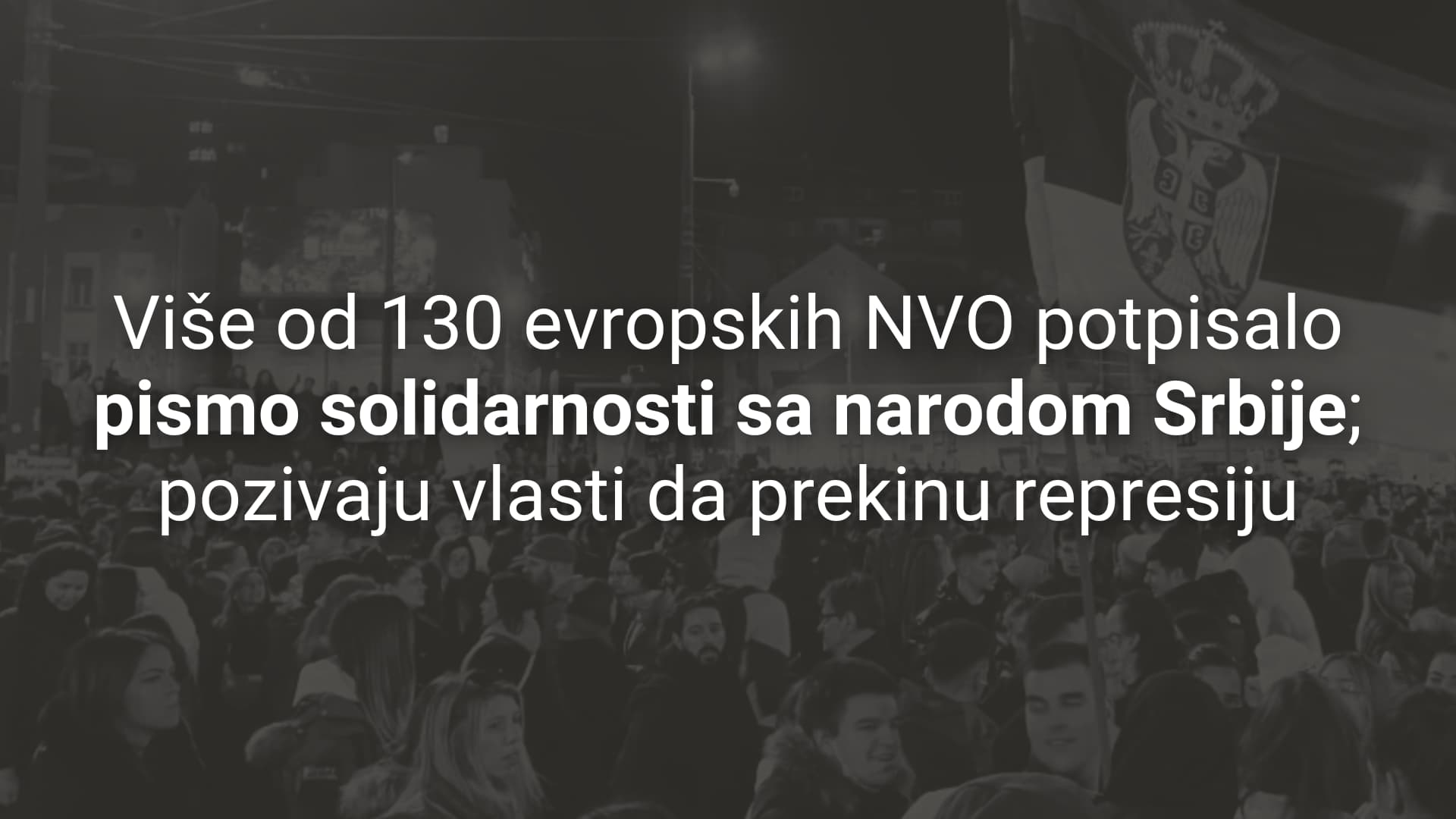
Over 130 European non-governmental organizations have signed a statement expressing solidarity with the people of Serbia, calling on the authorities to end the escalating repression of the anti-corruption movement.
In the statement, which was initiated by the European Civic Forum (ECF) and the Balkan Civil Society Development Network (BCSDN), these organizations describe the protest movement as “inspiring”, express solidarity with the struggle of the citizens of Serbia and emphasize that the repression of the movement is part of a wider trend of attacks on civil society in Europe.
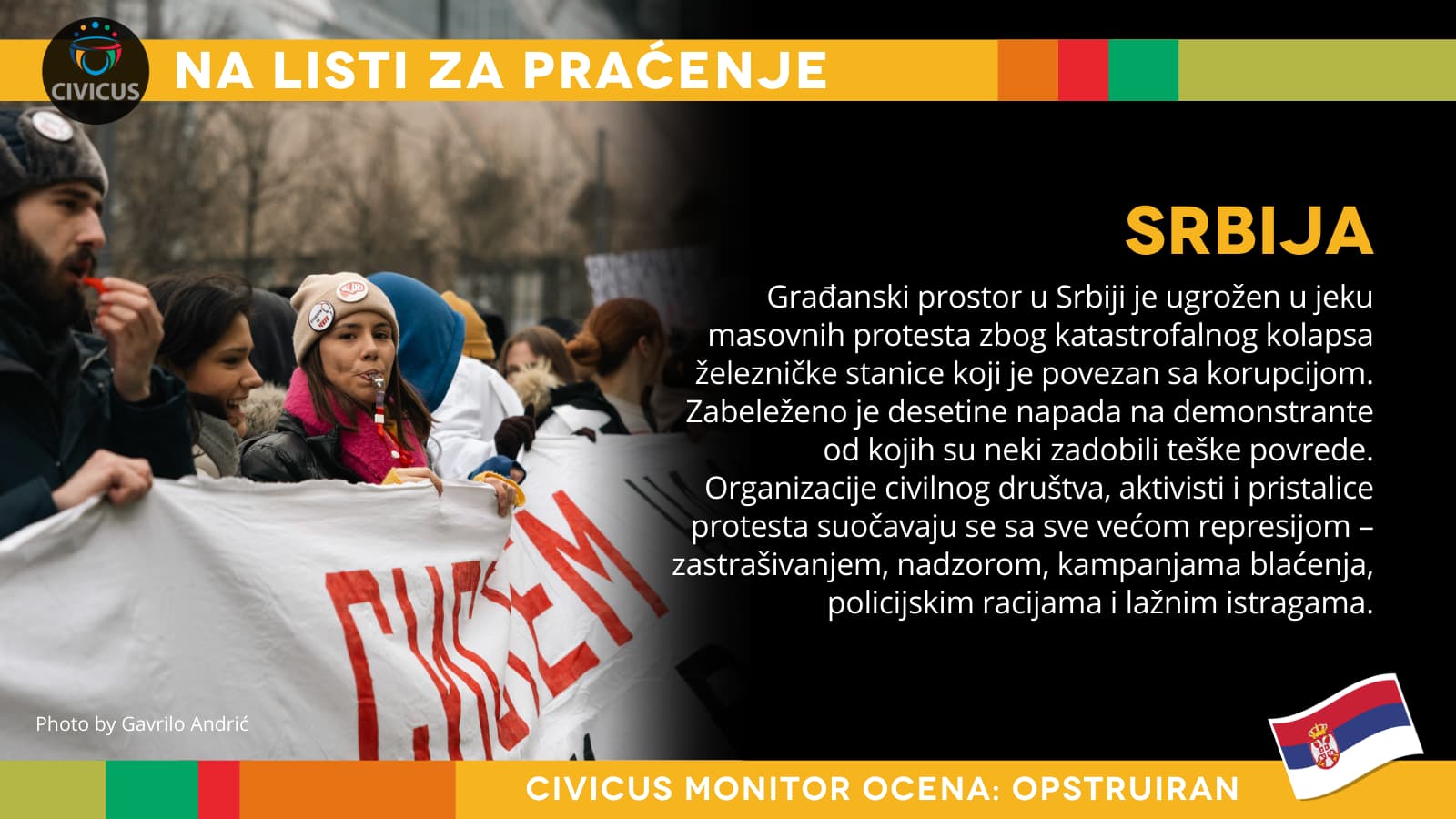
It comes as the global human rights organization CIVICUS Monitor has added Serbia to its latest watch list due to concerns about civil liberties violations.
The protests, which have spread to at least 245 cities and towns and brought tens of thousands of people to the streets, are deeply rooted in Serbian society and enjoy broad support from unions, farmers, bar associations, private businesses and self-organized citizens.
The signatory organizations also criticize the European Union, claiming that the EU’s inaction has contributed to deepening the mistrust of Serbian citizens towards the European path, weakening the enlargement process as a whole and discrediting the EU’s foreign policy.
Systematic efforts to stifle critical voices
Mass protests were caused by the tragic collapse of the renovated railway station in Novi Sad on November 1, 2024, in which 15 people died and two people were seriously injured. The incident exposed systemic corruption and government negligence, which is why protesters are demanding systemic changes and responsibility for the tragedy. The Government of Serbia responded to these legitimate expressions of grief and anger with increasing repression against civil society.
The scale of state violence and intimidation is deeply alarming. Dozens of attacks on protesters have been documented, including driving a vehicle into a crowd and a brutal attack on a female student by activists of the ruling party. Those who express support for the movement — students, professors, activists and independent voices — are accused of acting on behalf of foreign interests and face threats, surveillance, police interrogations and the loss of their jobs.
Authoritarian tactics
The actions of the Government of Serbia are only the latest escalation of a multi-year trend. For more than a decade, the country’s political leadership has systematically distanced it from the principles of democracy and the obligations necessary for EU integration. According to CIVICUS Monitor, the space for civil society action in Serbia is classified as “obstructed”, which further confirms the long-standing obstacles faced by those who advocate for democratization.
The signatories of the letter warn that these trends reflect authoritarian tactics, which many of them have already recognized and experienced in their countries.[1]
The European Citizens’ Forum (ECF) is a pan-European network of almost 100 associations and non-governmental organizations in 29 European countries. Founded in 2005 by our member organizations, we have been working for two decades to protect civic space, enable citizen participation in decision-making processes and build civil dialogue for more equality, solidarity and democracy in Europe.
About the Balkan Network for the Development of Civil Society
The Balkan Civil Society Development Network (BCSDN) is a regional network of local organizations for the development of civil society (CSOs) from the Balkan region (Albania, Bosnia and Herzegovina, Kosovo, North Macedonia, Montenegro, Romania, Serbia, Slovenia and Turkey).
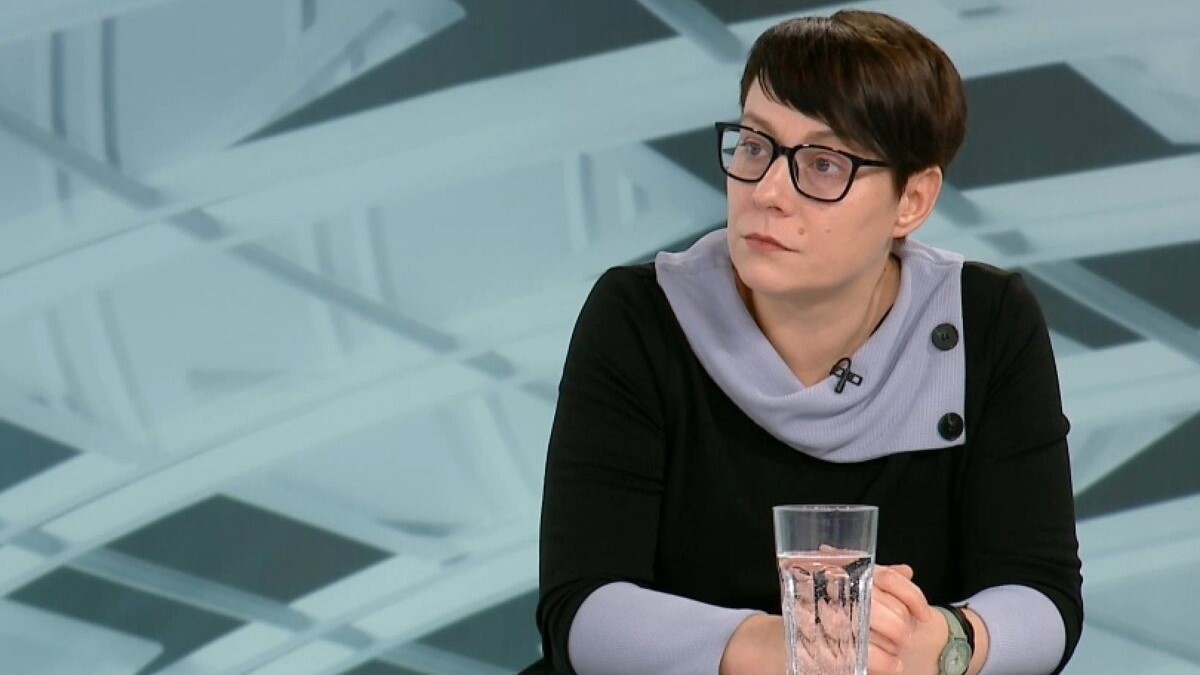
“Civil society in Serbia has been under pressure all the time since the large protests have been going on. Serbia has been added to the watch list of CIVICUS Monitor, because the authorities are seriously restricting civil space and inciting violence against tens of thousands of people protesting against corruption. Since February 25 and the police raid on the premises of the Civic Initiative, the atmosphere has been combative. The attacks of the authorities on a daily basis are more frequent and I think this is their nervousness because they cannot hold the strings in their hands. They are trying to find easy targets and deal with critics of the government,” Maja Stojanović, director of “Civil Initiatives”, told N1.
“On the warrant it was written that it was a pre-investigation procedure, but since then we have not received any information. We sent a complaint about the entire procedure because the police officers came without a warrant, stayed much longer than was necessary… So we did everything we could, because we want to influence that such behavior by the police and the prosecutor’s office stops,” Maja Stojanović, director of “Citizen Initiatives“, told N1.
She added that she and her family receive threats, as do other members of civil society organizations.
“The matter got even worse when we opened the protective mechanism ‘Shield’ for students whom we organized and offered legal aid. It was too much for the authorities, and then the attacks on me and my family began. But regardless of that, ‘Shield’ is always active, we have lawyers, these days we will announce a call for volunteers. ‘Shield’ is doing its job. Just yesterday we had about 20 educators who contacted us about salaries. People from other public institutions are also contacting us who are under pressure because they were at protests, so they received warnings before they were fired or suffered mobbing because of it. Our lawyers will work on those cases and active legal protection is organized. All those people gathered by ‘Shield’ make sure that March 15 goes well,” said Stojanović.
When asked whether they report cases of threats and whether and who can protect them if threats also come from the President of Serbia, Maja Stojanović says:
“We report threats to the police, we believe that they are there to protect us and the citizens and basic human rights. The problem, however, is the political control of the police and the prosecutor’s office, and it is difficult to fight against it. But if the citizens stand together against this type of government, the government cannot do much. In the coming days, we expect the government to be even more determined in its intention to remain in power illegally. In previous years, we also had problems that indicated that there would not be a democratic transition of government. And how this government is increasingly visible he is increasingly losing control of various structures and the pressure is increasing,” explains interviewee N1.
Stojanović also underlines that the role of civil society organizations is to take on most of the pressure from the government, so that students suffer as little as possible.
When asked whether the public discrediting of the government still has the same effect as before, Stojanović says:
“Public discrediting does not work for them. The majority of citizens saw that after their attacks we received the support of the academic public, students, and citizens, and I think that it is now known exactly who is on the level of human rights and who is violating them. It is another matter how much the government will threaten our security individually, that is another question.”
He states that reactions to all events in Serbia come from abroad as well as from international organizations.
“It is recognized that there are violations of human rights in Serbia. The situation is not calming down, the students are fighting successfully and this government is coming to an end. The president wishes for violence on March 15, this is indicated by the camp installed in Pionirski Park and the announcement of the arrival of even more people. It suits the authorities to have as much violence as possible in order to take extraordinary measures and get new mechanisms for action. But I don’t think that will happen, there will be no violence. The young people have repeatedly bypassed everything he wishes for and I think that March 15 will be an indicator of how many people are for a change of government, for the rule of law, and the number of people who will gather can influence the situation in the country,” concluded Maja Stojanović, director of the “Citizens’ Initiative”.
Watch the entire guest appearance in the video attachment.
Civic space is rapidly collapsing in the wake of mass protests against corruption that led to the disaster at the train station
Dozens of violent attacks on demonstrators were recorded, with some seriously injured
Civil society organizations face increasing pressure – smear campaigns, police raids and investigations based on trumped-up charges
These are the conclusions of the CIVICUS Monitor. whose announcement is transmitted below.
Serbia has been added to CIVICUS Monitor’s watch list as authorities severely restrict civic space and incite violence against tens of thousands of people protesting corruption.
This list includes countries where civic space is rapidly declining. In the first edition of the list for 2025, Serbia is in the company of four other countries with disturbed civil space, the Democratic Republic of Congo, Italy, Pakistan and the United States of America.
The authorities intensified the repression of the mass protest movement that broke out after the collapse of the canopy of the renovated railway station in Novi Sad in November 2024. The accident killed 15 people, while two were seriously injured. Public outrage is focused on corruption, and protests have spread to hundreds of cities and towns, gathering 100,000 participants.
“The rapid decline of civil liberties in Serbia is alarming. From legal harassment to outright intimidation, critical voices are under siege,” said Ine Van Severen, head of the Civic Space Research Program at CIVICUS.
“Despite these threats, citizens refuse to be silenced. Mass protests and widespread mobilization clearly show that demands for accountability are only getting stronger – people are fighting for their rights,” Van Severen said.
When the protests began, the authorities responded with arrests and excessive use of force. Later, the police withdrew, allowing thugs linked to the ruling party to attack the protesters. On November 22, 2024, during the distribution of mail to the victims, students and professors of the Faculty of Dramatic Arts in Belgrade were attacked. In the attack, one student was hospitalized, and a journalist was injured, which caused blockades at state universities until the protesters’ demands were met.
State repression intensified. Over 70 attacks on protesters have been recorded, including cases in which vehicles were driven into crowds, as well as an attack by supporters of the ruling party armed with baseball bats in which a female student was seriously injured and hospitalized. The Prime Minister resigned on January 28, 2025, and a decision on the reconstruction of the government or the calling of early elections is expected this month.
“The government is increasingly working to suppress critical voices. Officials and pro-government tabloids are smearing protesters and civil society, inciting violence by labeling them ‘enemies of the state’. Arbitrary arrests, cases of illegal surveillance and leaks of personal data are on the rise.” said Uroš Jovanović, public policy program manager at Civic Initiatives.
“Nevertheless, the growing volume of anti-corruption protests shows the determination of citizens to advocate for change,” Jovanović pointed out.
On February 25, 2025, armed police raided five civil society organizations, detaining staff and seizing financial documents without a court order. Authorities launched financial investigations against prominent critics on trumped-up charges. Amnesty International has documented the illegal use of spyware against activists and journalists.
“The repression of civil society in Serbia reflects a regional trend. We are witnessing systematic efforts to weaken independent civil voices across the Western Balkans. Civil society plays a key role in defending rights and calling for accountability, but is treated as a threat, not a partner.” said Anja Bosilkova-Antovska, Head of Policy and Public Advocacy at the Balkan Civil Society Development Network (BCSDN).
“Civil space in Serbia is rapidly collapsing, and urgent international action is necessary to prevent further regression and protect basic freedoms.”
———
On the rating of Serbia’s civic space “obstructed”:
This rating is given to countries where the authorities seriously challenge civil space, imposing legal and practical restrictions on the full enjoyment of fundamental rights (full description of ratings available here). You can view the Watchlist FAQ here.
A total of 35 countries in the world have this rating (list available here).
About the CIVICUS Monitor Watchlist:
The new watchlist was released by CIVICUS Monitor, an online platform that tracks the latest developments in civil liberties, including freedom of expression, association and peaceful assembly, in 198 countries and territories.
Civic space in countries is categorized into five levels: “closed”, “repressed”, “obstructed”, “narrowed” and “open”, based on a methodology that combines multiple sources of data on freedom of association, peaceful assembly and expression. The score “obstructed” indicates a medium level of restriction. It describes an environment in which the authorities disrupt the work of civil society organizations, protesters are subjected to excessive force, and independent media and editorial freedom are severely restricted.
Over twenty organizations collaborate to provide reliable evidence and stimulate action to improve civic space on all continents.
Read the report People Power Under Attack 2024:link
Violation of basic human rights in Serbia February 14 – March 6, 2025
The deep political crisis that Serbia is in is also reflected in numerous violations of basic freedoms recorded in the observed period.
In Belgrade, on February 25, members of the Criminal Police Directorate, on the order of the Special Department for Suppression of Corruption of the Higher Public Prosecutor’s Office in Belgrade, raided the premises of five non-governmental organizations: Civic Initiatives, CRTA, Trag Foundation, Center for Practical Politics, and the Umbrella Organization of the Youth of Serbia. The Prosecutor’s Office ordered the collection of information from these pro-democracy non-governmental organizations, all because of statements made by American officials against USAID. The raid comes at a time when the government is trying to present the current protests in Serbia as an attempt at a “color revolution” and after a months-long hunt by officials and tabloids on civil society, which loudly points to all human rights violations and irregularities in the work of the authorities.
The Basic Public Prosecutor’s Office in Loznica filed an indictment against the activist of the “Ne damo Jadar” association Zlatko Kokanović from Gornji Nedeljice, in connection with the blockade of the railroad crossing from last year, and requested a prison sentence of 14 months. This is the first indictment related to environmental protests against lithium mining, and the proposed sentence in Zatvor is a serious danger for all citizens who faced arrests and detentions due to their activism during the previous year.
For more information about these and other cases recorded in the previous period, see the full report below: