


Published: December 9, 2025.
- Drop from the “obstructed” category to the “under repression” category
- Basic freedoms in deep crisis as authorities step up pressure on persistent protests
- Protesters face violence from the police and groups linked to the ruling party, mass arrests and intimidation
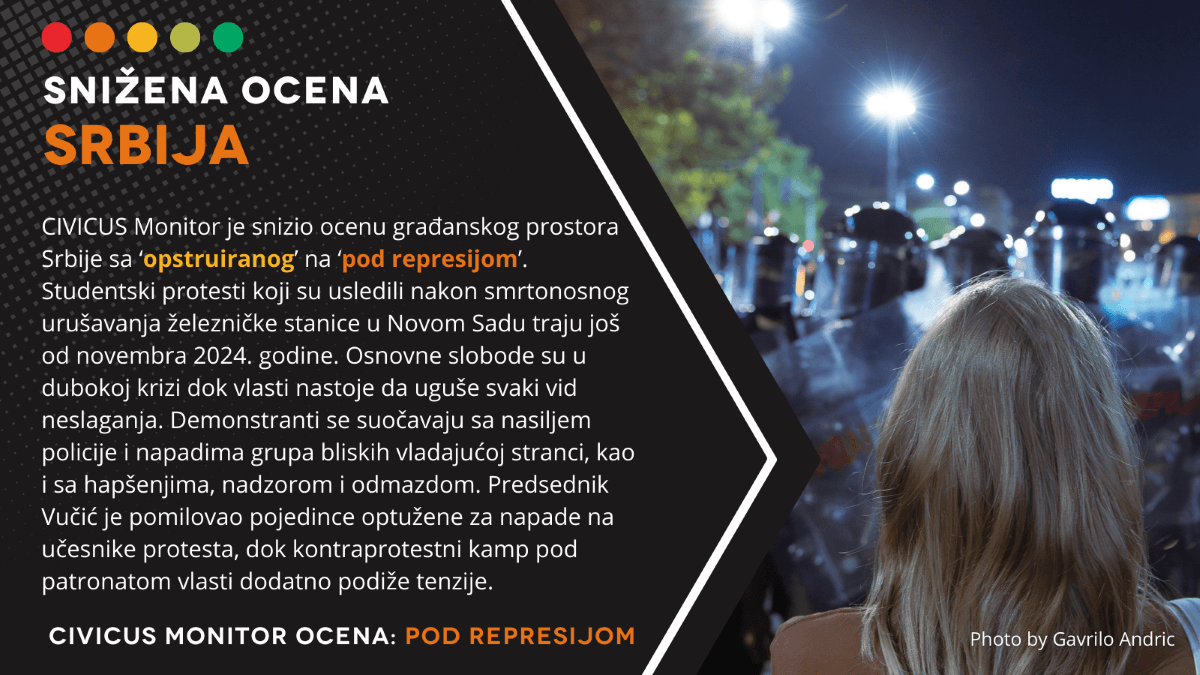
In its latest report, CIVICUS Monitor announced that it had lowered its assessment of civic space in Serbia to the level of “under repression”. This represents a turning point after years of escalating attacks on basic freedoms. The “repressed” category — the second lowest in the global framework — refers to states where the space for citizen action is severely limited, and dissent from the government carries severe consequences, including violence, prosecution or even prison terms. Thus, in 2025, Serbia will join the group of 50 countries with the status “under repression”, among which are Georgia, Zimbabwe, Pakistan and El Salvador.
“The downgrade for Serbia is a turning point,” said Ine Van Severen, head of CIVICUS Monitor’s research. “The authorities are no longer just trying to suppress criticism, but are actively stifling the right to free expression, association and protest. A state that claims to pursue democracy must not persecute citizens for demanding accountability.”
The student protests, which broke out after the deadly collapse of the train station in Novi Sad, attributed to corruption, have been going on since November 2024. At the same time, basic freedoms are under strong attack due to the increasingly repressive moves of the government. Protesters and those who support them face police violence, attacks by groups linked to the ruling party, mass arrests and intimidation campaigns, while the perpetrators of such attacks enjoy almost total impunity.
Human rights organizations say that more than 1,000 people have been detained since the beginning of the protests. Most were soon released, but some are still under house arrest or under restricted movement measures. Twelve civil society and opposition activists face criminal prosecution on disputed charges of allegedly subverting the constitutional order, while six of them are already in exile.
In July, President Aleksandar Vučić pardoned people accused of serious violence against protesters, including four men associated with his party who brutally beat a female student, as well as a woman accused of attempted murder after she drove her car into a crowd of protesters. Authorities have refused to seriously investigate allegations of police abuse, from excessive use of force at protests to beatings and threats of sexual violence reported by student Nikolina Sinđelić. They also failed to launch effective investigations into the alleged use of stun guns at the March 15 protest or into reports of the use of spyware against journalists and human rights defenders.
The authorities further exacerbated tensions by organizing counter rallies and camps around key institutions in Belgrade. Investigative journalists identified persons connected to organized crime among the participants. With the support of local authorities and police protection, these camps became places of frequent clashes with anti-regime demonstrators.
“The ruling party now permeates every segment of public life, making pressure inevitable,” says Uroš Jovanović, from Civic Initiatives. “Serbia has become a country where even a single critical word attracts retaliation. That retaliation can take the form of job loss in the public or publicly funded sector, targeted inspections by state authorities, smear campaigns in the media close to the ruling party, arbitrary detentions or various forms of administrative harassment.”
Freedom of assembly could soon be even more threatened. The proposed amendments to the Criminal Code from September 2025 provide that any traffic blockade becomes a criminal offense punishable by up to one year in prison, which, as civil society organizations warn, would in practice mean the criminalization of peaceful protest.
And freedom of expression is under constant attack. Those who publicly and vocally support the protests face smear campaigns, pressures and dismissals. More than a hundred employees in education lost their jobs due to support for student blockades. Independent media are also under attack: there were allegations that President Vučić personally influenced the takeover of critical television stations N1 and Nova, and politically motivated and legally questionable appointments to the Council of the Regulatory Body for Electronic Media ensured that this institution remained under the full control of the ruling party.
“This downgrade is not a surprise. We have been warning for years that the position of civil society must be at the center of the EU accession process. The situation in Serbia clearly confirms this,” said Simona Mladenovska from the Balkan Network for the Development of Civil Society. “When justice is delayed, it means there is none — for grieving parents, for journalists, for activists and all those silenced by repression. Now it is up to the European Union to act, protect civil space and ensure accountability.”
CIVICUS calls on the authorities in Serbia to immediately stop violence and politically motivated criminal prosecutions, withdraw changes that would criminalize peaceful gatherings, and launch independent investigations into abuses of police powers and illegal surveillance.
CIVICUS Monitor is a research tool that monitors the state of civil liberties in 198 countries and territories, generating quantitative and qualitative assessments of civic space. The data is collected in cooperation with more than 20 research partners from the civil sector and independent human rights assessments. Civic space can be evaluated in five possible categories: open, narrowed, obstructed, under repression and closed.