

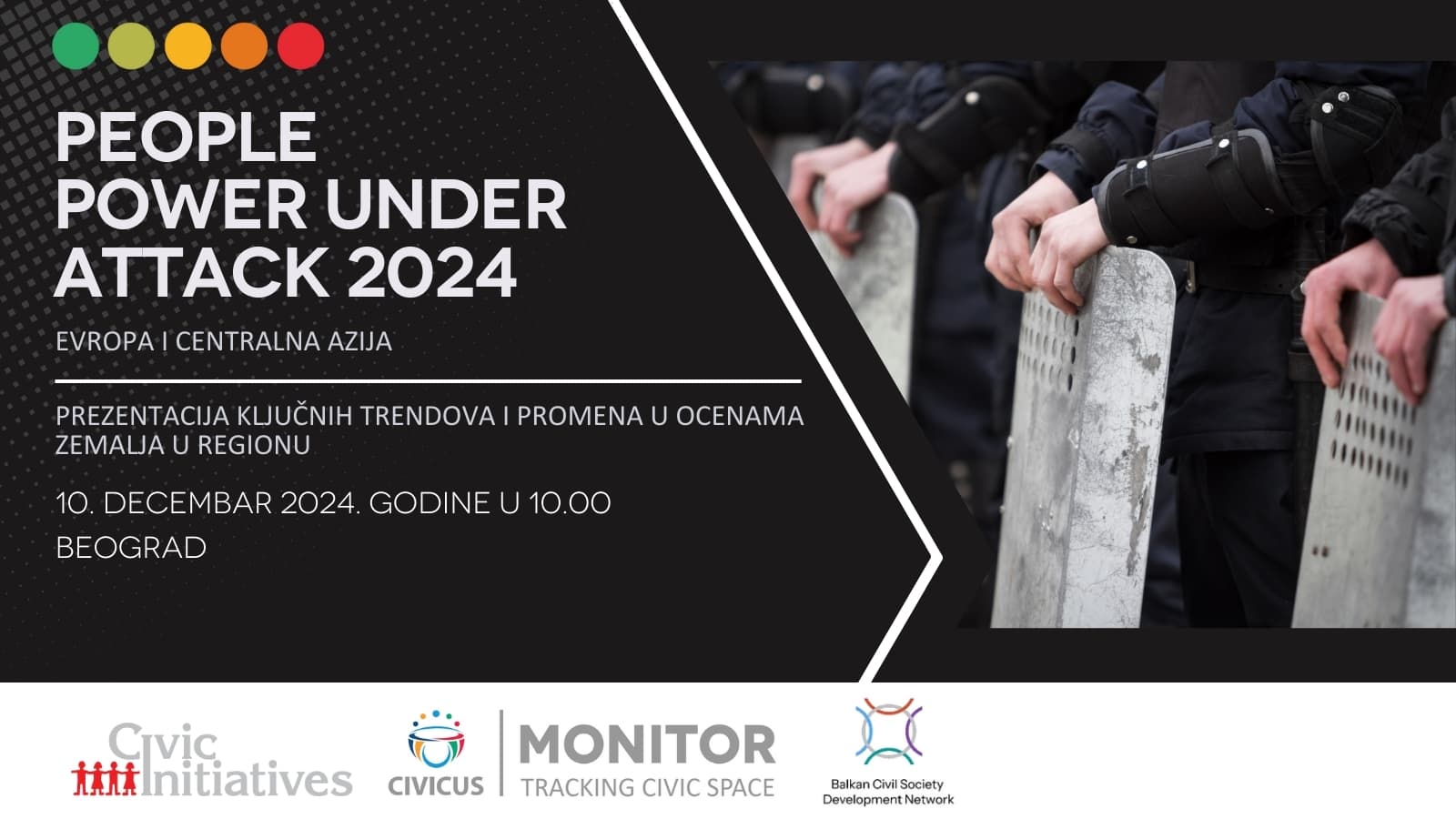
We invite you to join us for the launch of the People Power Under Attack 2024 report and findings for Europe and Central Asia by the international NGO CIVICUS. The presentation of the report will be held on December 10 in the “Miljenko Dereta” space (Dobračina 55), starting at 10 a.m.
The report will be presented by Tara Petrović, CIVICUS Monitor’s civic space researcher. After the presentation, there will be a panel discussion in which representatives of civil society organizations from Slovenia, Bosnia and Herzegovina, Georgia and Serbia will participate. They will link specific challenges in their countries to the report’s findings. The event is in English, but simultaneous translation into Serbian will be provided. Below we provide you with the key findings of this report, with a focus on Europe and Central Asia.
In the Europe and Central Asia region, significant changes in the conditions for civic space in 2024 were recorded. Based on data collected by over 20 research teams covering 198 countries and territories, the CIVICUS Monitor platform rates civic space in all countries of the world from 0-100, placing them in one of five categories. The most recent estimates show that of the 54 countries in the region, 19 are rated as “open”, 19 as “narrowed”, seven as “obstructed”, three as “repressed” and six as “closed”.
Key trends in the region include the spread of dangerous “foreign agent” laws, such as the one recently proposed in Serbia, and “LGBT propaganda” – laws by which authorities throughout the region introduce censorship and threaten human rights under the guise of protecting national interests and traditional values. During 2024, such laws were proposed or adopted in several European Union countries – Hungary, Slovakia and Bulgaria, as well as elsewhere in the region, including Turkey, Kyrgyzstan and Uzbekistan. In Georgia, the passage of a law on foreign agents sparked mass demonstrations, to which the authorities responded with violent repression, earning the country a downgraded civic space rating in the latest report.
The report’s findings also show that the right to protest is under threat around the world. CIVICUS Monitor found that arresting protesters is by far the most common tactic used to limit the rights to freedom of expression, assembly and association. At the global level, but also at the level of Europe, the protests of activists for the protection of the environment, as well as the protests in solidarity with Palestine, were specifically targeted.
In addition to the arrests of protesters, in Europe and Central Asia the most common civil rights violations recorded in 2024 were the breaking up of demonstrations, often with the use of excessive force, as well as the prevention of protests and the arrest of journalists.
This year, Serbia is also in the category of “obstructed” countries, with 49 out of 100 points. However, due to a significant decline in the state of civil liberties, Serbia was highlighted as a “country of interest” in the report this year. The report states that in 2024 there was an increase in civil unrest related to the renewal of a controversial lithium mining project. The project, which was paused in 2022 after mass protests, was revived in July 2024 as part of a strategic partnership between the EU and Serbia with the aim of meeting up to 90% of Europe’s lithium needs for electric vehicles. This decision caused renewed public discontent, resulting in mass protests across the country. Civil society organizations reported that dozens of activists were arrested in 17 cities in August, and that many were charged with “calling for the violent overthrow of the constitutional order.” Those accusations were often based on their social media activity or participation in protests. Although most detentions were short-lived, activists and human rights organizations condemned the use of arrests and other measures, such as anonymous threats and prolonged detentions at borders, as a tool of intimidation.
The government further escalated tensions by presenting resistance to the lithium exploitation project as a foreign-backed effort to destabilize Serbia. Senior officials and pro-government media accused civil society organizations of organizing a “color revolution” with the alleged support of Western countries, despite the same countries publicly supporting the project. Media such as the tabloid Informer published sensitive information about civil society organizations, allegedly leaked from state agencies, including data on donors, financial transactions and employees. The situation worsened after the tragic collapse of the recently renovated train station in Novi Sad in November, which killed 15 people and sparked new protests. Authorities responded with increased repression, including excessive use of force and arrests of protesters by plainclothes police officers who refused to identify themselves, raising serious concerns about human rights abuses and the safety of protesters.
Slovenia was upgraded from a “narrowed” to an “open” civic space. The current government has improved the dialogue with civil society, introduced new consultation mechanisms and reformed the public broadcaster RTV Slovenia. Poland was upgraded from an “obstructed” rating to a “narrowed” civic space. After the change of government, steps were taken to address issues such as the independence of the judiciary and improving relations with civil society. However, concerns remain regarding media reforms and migration policies. The Netherlands was downgraded from “open” to “narrowed”. The authorities have increasingly disrupted peaceful environmental protests, using measures such as water cannons and mass arrests. Georgia experienced a decline in civic space from “narrowed” to “obstructed”, with increased restrictions on freedom of expression and assembly.