Violation of basic human rights in Serbia May 8 – May 21, 2026
During the last reporting period, incidents and violations of the right to freedom of expression, assembly and association were recorded in several separate cases. In Novi Sad, parents and students of the “Jovan Jovanović Zmaj” Gymnasium protested the actions of the school administration, after the principal restricted the movement of students during the school day and prevented some of them from leaving the building. In Kraljevo, there was a case of public publication of the names and surnames of students and citizens who participate in or support student activities, which directly led to endangering their safety. Journalists’ associations continue to warn of continued threats and pressures against journalists and media workers, including threats directed at journalists via social networks and direct messages, as well as cases of interference with their work during reporting.
For more information about these and other cases recorded in the previous period, see the full report below:
The National Working Group for the Fight against SLAPP expresses serious concern regarding the verdict of the Second Basic Court in Belgrade, by which the Slavko Ćuruvija Foundation is obliged to pay a total of 1,035,000 dinars to Milan Radonjić, Ratko Romić and Miroslav Kurak, after former members of the State Security sued the Foundation for a statement expressing dissatisfaction with the final acquittal of the Court of Appeal in the case of the murder of journalist Slavko Ćuruvija.
Radonjić, Romić and Kurak, who were first convicted and then legally acquitted in the proceedings related to the murder of Slavko Ćuruvija, initiated proceedings against the Foundation because of its public response to the court’s decision. According to the verdict, the Foundation should pay each of the plaintiffs 200,000 dinars for non-material damages “due to mental pain caused by the injury to honor and reputation”, as well as 320,000 dinars for the costs of the litigation, 90,000 dinars for court fees and an additional 25,000 dinars to Kurak for the costs of the litigation.
The National Working Group believes that this case is a textbook example of a SLAPP lawsuit – a strategic lawsuit against public participation, the goal of which is not to protect rights, but to intimidate, financially exhaust and deter organizations, journalists, activists and other actors from speaking publicly on topics of undoubted public interest.
The murder of Slavko Ćuruvija is one of the most important unresolved issues for media freedom, the rule of law and democratic society in Serbia. The public debate on the judicial process for the murder of journalists, the actions of institutions and the responsibility of the state must not be treated as an illegal attack on honor and reputation, but as a legitimate participation in a debate of the highest public importance.
It is especially important to point out the fact that in the meantime the Supreme Court found that in the acquittal of the Court of Appeal in the case of the murder of Slavko Ćuruvija, there were significant violations of the provisions of the criminal procedure in favor of the defendants, former members of the state security who sued the Foundation because of the reaction to the acquittal. However, due to legal restrictions, the trial cannot be repeated. This further confirmed that the public criticism of the acquittal was based on an issue of indisputable importance for the public.
We remind you that the trial for the murder of Slavko Ćuruvija began in 2015, and that the first-instance court twice issued a verdict by which the four defendants were sentenced to a total of 100 years in prison. With the last decision, the Appellate Court acquitted them, thus this case, despite years of court proceedings, remained without justice for the murdered journalist and his family.
European standards clearly recognize SLAPP proceedings as a serious threat to freedom of expression, media freedoms and citizens’ right to be informed. The European Union’s Anti-SLAPP Directive provides procedural safeguards for persons and organizations speaking out on matters of public interest, including the possibility of early dismissal of unfounded claims, reimbursement of costs and other measures against abuse of process.
The Council of Europe also adopted recommendations for member states to develop effective mechanisms to prevent and sanction SLAPP proceedings, with special protection for journalists, media, civil society organizations and other public “guardians of democracy”.
The National Anti-SLAPP Task Force warns that such rulings directly narrow the space for public debate and encourage further use of the judiciary as an instrument of pressure.
The national working group calls on the courts to consistently apply the standards of the European Court of Human Rights on freedom of expression in proceedings related to public debate. We point out the importance of the courts consistently applying the standards of freedom of expression and recognition of legitimate public criticism in such proceedings. We also point out that the domestic legal framework already contains procedural mechanisms to prevent the abuse of the right to judicial protection and the conduct of proceedings that may have a deterrent effect on freedom of expression, and that their consistent application is of particular importance.
The public has the right to know how the institutions acted in the case of the murder of Slavko Ćuruvija. Any punishment of such speech represents a dangerous precedent and a direct attack on freedom of expression, media freedom and democratic control of institutions.
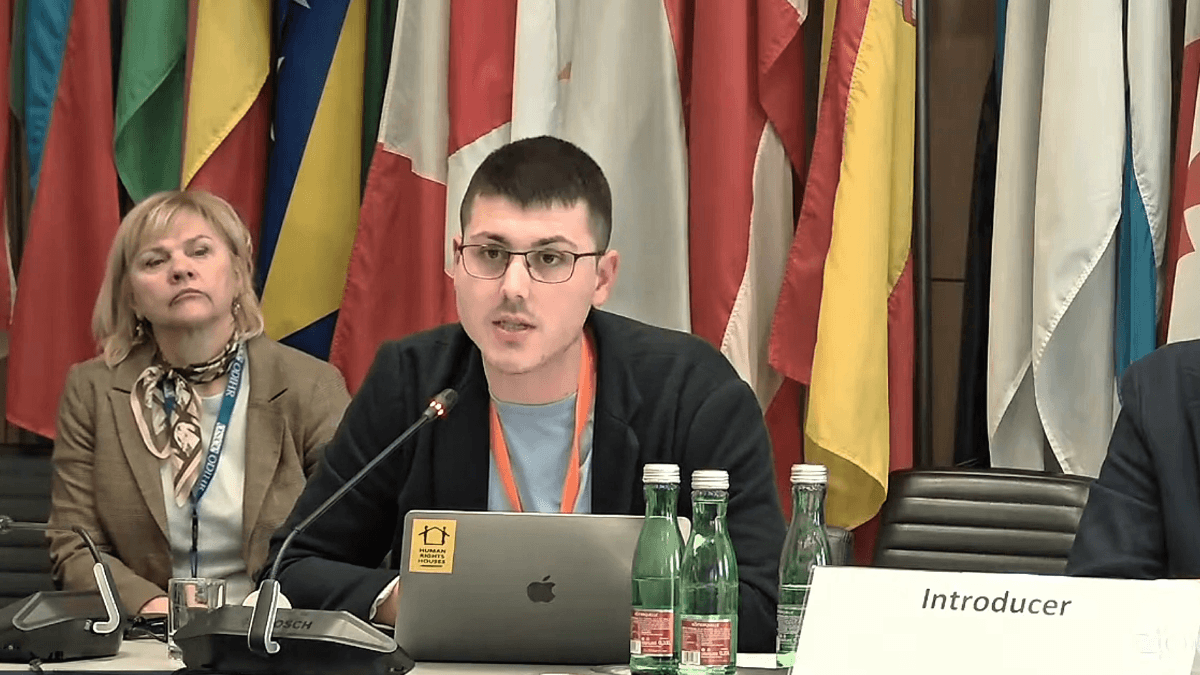
Digital threats to civil space are no longer abstract risks, but a reality that human rights defenders, journalists and activists in Serbia face more and more often, said Uroš Jovanović from Civic Initiatives at the Supplementary Meeting on the Human Dimension organized by the OSCE Office for Democratic Institutions and Human Rights, held in Vienna.
“Human rights defenders are increasingly facing digital surveillance and public intimidation with the aim of silencing critical voices. Documented cases involving highly invasive surveillance technologies, including “zero click” software – spyware that can access people’s mobile phones without any user action, as well as forensic tools to unlock phones in police stations and many others, are of particular concern, as stated in Amnesty International’s 2024 report “Digital Prison” on Serbia. year,” said Jovanović.
As he stated, in Serbia and throughout the region, digital surveillance often goes beyond the online sphere. Private communications and personal data often appear in pro-government tabloids and coordinated media attacks targeting investigative journalists, activists and government critics.
“Many civil society actors from Serbia, many of them present in this hall, are increasingly operating under the assumption that their communications can be monitored, leaked and misused against them,” said Jovanović.
He also warned that surveillance technologies affect the exercise of the right to peaceful assembly, as the use of spyware and digital surveillance during protests can discourage citizens from participating and further undermine democratic engagement.
In particular, it was pointed out that female journalists and human rights defenders are exposed to gender-based online violence and coordinated digital attacks.
“Citizens’ initiatives call on OSCE participating states to ensure strict legal guarantees, independent oversight, transparency and effective legal mechanisms regarding the use of surveillance technologies. Where serious allegations remain insufficiently investigated at the national level, which is the case in Serbia, participating states should make greater use of existing human dimension mechanisms,” said Jovanović.
Violation of fundamental human rights in Serbia March 27 – April 9, 2026
During the last reporting period, in several separate cases, we recorded incidents and violations of the rights to expression, assembly and association. At the Faculty of Medicine in Belgrade, it was assessed that the election process for the student parliament at that faculty was compromised, while in Novi Sad, a University professor suffered a physical attack because of the “Students win” sticker. In Inđija, citizens and activists were intercepted in the very center of the city, while in Lajkovac, the directors are changing again for political reasons. Journalists’ associations warn of deteriorating security and pressures on freedom of expression, while almost at the same time, SNS officials insult the journalists of the N1 television.
For more information about these and other cases recorded in the previous period, see the full report below:
Violation of basic human rights in Serbia April 10 – 23, 2026
Recent events across Serbia indicate a dangerous trend of coordinated use of force, institutional pressure and direct violence against those who express any kind of disagreement with official policy. In Valjevo and in front of the Faculty of Agriculture in Belgrade, actions were taken to arrest students and citizens by masked persons who refused to show identification. In Bor, a young football player was kicked out of the club because he refused to attend a party meeting, while an employee of “JKP Gradska čistoća” was attacked from behind, for talking about corruption. In Novi Sad, the bus driver Miomir Jaćimović was intentionally set on fire, and attacks on students continue during almost all student actions.
For more information about these and other cases recorded in the previous period, see the full report below: