


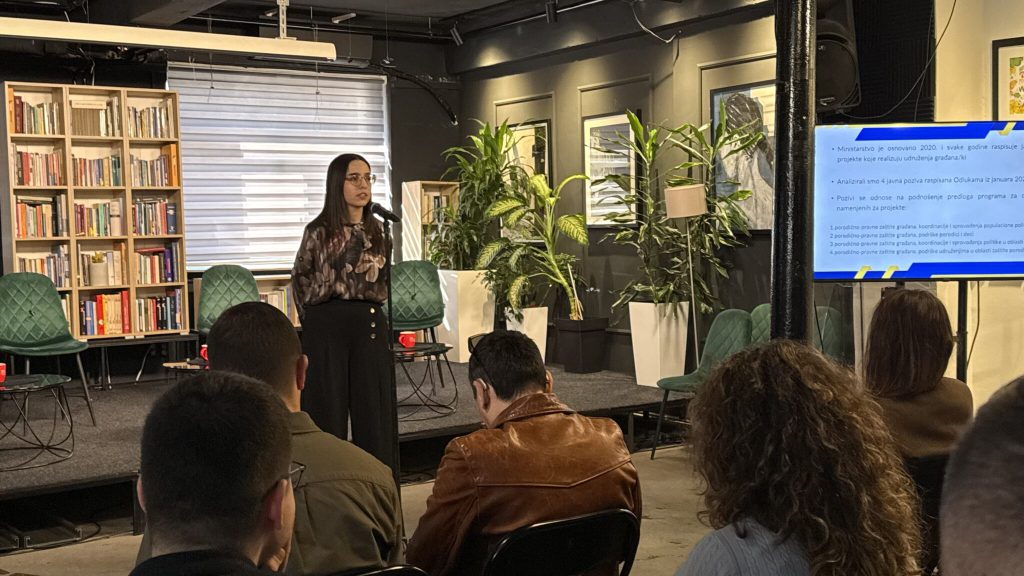
For 35 projects funded with more than 92 million dinars in the competitions of the Ministry of Family Care and Demography, there is no publicly available data on their implementation, an analysis by Civic Initiatives shows. This is more than half of the funds allocated to the four January tenders in 2024. Some organizations without visible activities continued to receive budget funds in 2025.
The findings of the analysis were presented today along with BIRN Serbia’s research into millions of dollars awarded to organizations close to the government in a competition run by the Ministry of Environmental Protection, with the assessment that the questionable funding patterns are repeated year after year.
The analysis of Civic Initiatives included four public competitions announced by the Ministry of Family Care and Demography in January 2024. A total of 75 organizations were supported in these competitions with 176,700,553 dinars.
According to the analysis findings:
- 36 organizations do not have active profiles on social networks or their last activity was recorded several years ago;
- for 35 projects worth 92,170,163 dinars, no information was found on implemented activities, results or reports;
- 10 of those 35 organizations received funding again in 2025, in a total amount exceeding 8.2 million dinars;
- The highest individual amount per project was 6,000,000 dinars – four organizations received this maximum amount, while for three projects no information on implementation was found, and for the fourth there is only news about a conference held.
Alma Mustajbašić from Civic Initiatives pointed out that the Ministry of Family Care and Demography continued the practice of financing non-transparent projects and organizations.
“Money from the budget intended for projects of public interest goes to projects that are in no way visible to the public. This has wider negative social consequences, because money for projects that should contribute to improving the position of marginalized social groups and solving systemic social problems goes to organizations that only exist on paper. Of course, negative consequences are also faced by organizations that have many years of experience and relevant knowledge in the areas of the competition, and which remain deprived of funds, or receive very small amounts that cannot ensure the long-term sustainability of their activities. This most directly threatens the survival of organizations, and also endangers users who are left without the necessary services and support that these organizations provide,” said Mustajbašić.
You can download the complete analysis of the Ministry of Family Care and Demography’s competition by clicking the button below:
BIRN Executive Editor Gordana Andrić said that in the first competition of the Ministry of Environmental Protection, after a five-year break, almost 20 million dinars, which is almost half of the total amount, were awarded to associations connected to political officials or close to ruling structures, to those without clearly visible activities or to organizations that did not meet the formal requirements of the competition.
As she specified, the money was received by at least nine organizations connected to government structures, as well as at least 19 phantom organizations because there is no trace of their work, while the relevant organizations have not even heard of them.
An example is the association “Zeleni Sad” from Novi Sad, founded by the Minister of Environmental Protection Sara Pavkov, which has received at least 9.5 million dinars from various public budgets since 2019.
“Pavkov was the representative of the association until the end of 2020, and from the moment she became a public official until she left it, it received at least 800,000 dinars in a competition run by the City of Novi Sad and the Provincial Secretariat for Sports and Youth,” Andrić stated.
Also, although she left her position as the association’s representative after taking up her first public office six years ago, the headquarters of “Zeleni Sad” was in a building she owned until last year, and the organization was in the hands of her associate.
After the presentation of the research results, a panel discussion “Already seen: continuation of controversial practices in financing organizations” was held, with speakers Aleksandar Nikolić, Union of High School Students of Serbia, Alma Mustajbašić, Civic Initiatives, and Bojan Cvejić, ANEM.
See the entire event in the video below: