


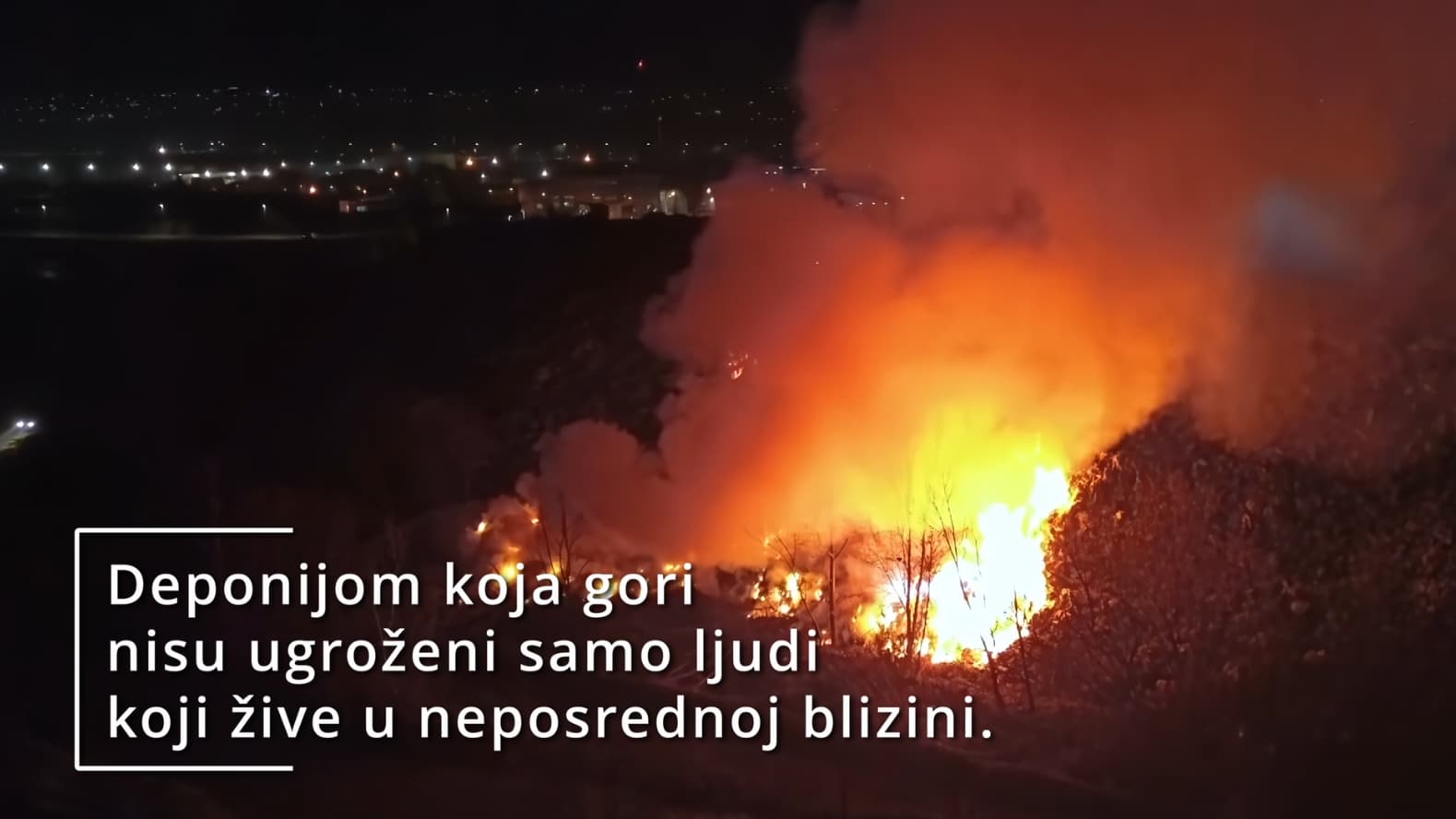
The story of unsanitary landfills is again in the center of attention. Since the beginning of this year, the landfill in Valjevo has burned several times, and the citizens have started blocking its access and preventing garbage disposal, in order to point out again that this unsanitary landfill has been endangering their health for decades.
The problem of unsanitary landfills has been burning in the literal sense for several years, and Valjevska is only one of those where the situation is most urgent. Milan Ninić has lived all his life 200 meters from the landfill. As he says, in some periods of the year, the stench is the least of the problems.
“In addition, the landfill brings mice, rats, birds, bags, various garbage that flies and falls into the yard. It brings us various diseases, it’s all there.”
However, the stench is not negligible either, especially in the summer.
“We are forced to open the windows less, air the house less, there is no playing for the children in the yard. We are going to the city, literally, to take the children outside,” says Milan Ninić.
Valjevo is one of the many cities where burning landfills additionally pollute the air.
“For years, Valjevo has been the most polluted city in terms of PM 10 and PM 2.5 particles, and the residents who live next to the landfill have a slightly more tragic fate, because several types of pollution accumulate there. One of the particles that comes in the winter is from the Valjevo heating plant, and the thing that most threatens the health of Valjevo residents from that area is when the landfill burns,” believes Vladimir Radosavljević from iRevolution.
In addition to Valjevska, landfills in Uzice, Kraljevo, Mladenovac, Temerin and many other places burned in the previous period.
“Fires at landfills have tripled in the last seven years. We usually hear that a landfill has caught fire in the summer, but they burn all year round,” says Nataša Gligorijević, coordinator of the Eco block – network for cleaner air.
The impact of burning landfills on human health is worrisome.
“Landfills that are not sanitaryly secured affect all organ systems of all living beings. Living near a landfill causes the most consequences for the respiratory system, leading to allergies, slowed development and growth in children, heart problems, problems with circulation, nervous system. It is frightening that living near a landfill leads to anxiety, depression, sleep and learning problems,” warns Mirjana Nastasić, activist, graduate student in medicine and member of the Contemporary Educational Network.
According to Nastasić, not only the people who live in the immediate vicinity are threatened by the burning landfill, because particles, gases and heavy metals fly and end up in the air, water, and through the soil they end up in food.
There are 2,689 official landfills in Serbia, and more than 3,500 unofficial ones. Only 12 regional sanitary landfills were built, instead of the planned 26.
“The problem is that waste is not only disposed of in sanitary landfills, which are subject to certain controls, but most local self-government units have their own unsanitary landfills, so-called landfills, where the capacities are almost full,” Nataša Gligorijević warns.
Inadequate disposal of waste is certainly the biggest cause of increasingly frequent fires at landfills.
“At such landfills, there are neither gates, nor guards, nor a monitoring system for landfill gas, which is created by the disposal of biodegradable waste, which produces gas, more than 50% of that gas is methane, which when it comes into contact with certain substances causes explosions and fires.”
The solution to the above landfill problem is certainly not simple, in the first place it is necessary to create a waste management system, and the first step is separation.
The body of the landfill must be constantly covered with certain materials, in order to prevent both fires and air pollution. In addition to using all the necessary filters, it is necessary to carry out regular systematic inspections of the residents who live near the landfill, advise our interlocutors.
Watch the whole story in the video attachment:
This video was created as part of the “Garden, Ashes” initiative, which is implemented with the support of the Swiss Government project “Together for an active civil society – ACT”, implemented by Helvetas Swiss Intercooperation and Civic Initiatives. The opinion expressed in this video does not necessarily represent the opinion of the Government of Switzerland, Helvetas or Civic Initiatives.