

March 10, 2025.
- Civic space is rapidly collapsing in the wake of mass protests against corruption that led to the disaster at the train station
- Dozens of violent attacks on demonstrators were recorded, with some seriously injured
- Civil society organizations face increasing pressure – smear campaigns, police raids and investigations based on trumped-up charges
These are the conclusions of the CIVICUS Monitor. whose announcement is transmitted below.
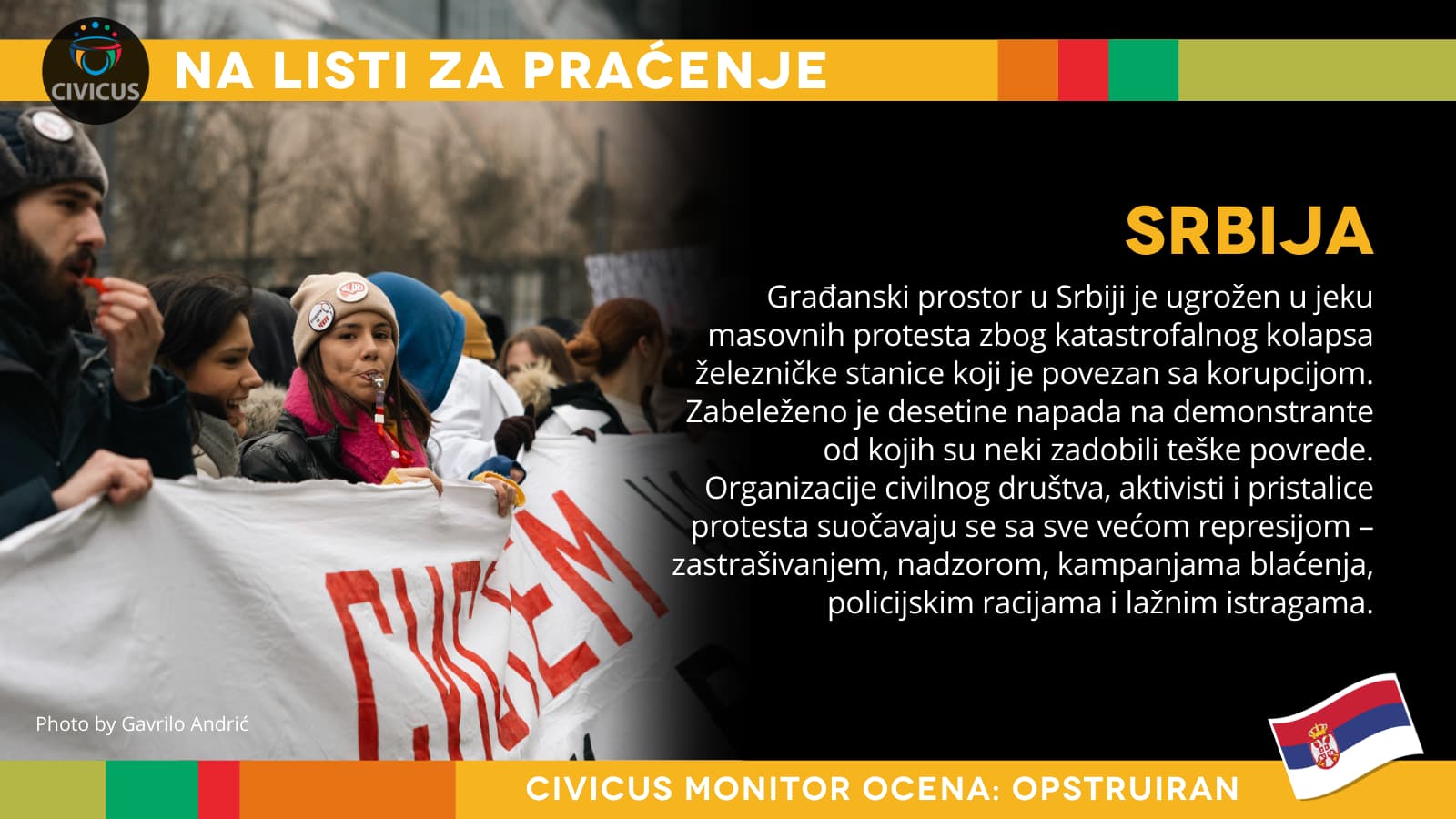
Serbia has been added to CIVICUS Monitor’s watch list as authorities severely restrict civic space and incite violence against tens of thousands of people protesting corruption.
This list includes countries where civic space is rapidly declining. In the first edition of the list for 2025, Serbia is in the company of four other countries with disturbed civil space, the Democratic Republic of Congo, Italy, Pakistan and the United States of America.
The authorities intensified the repression of the mass protest movement that broke out after the collapse of the canopy of the renovated railway station in Novi Sad in November 2024. The accident killed 15 people, while two were seriously injured. Public outrage is focused on corruption, and protests have spread to hundreds of cities and towns, gathering 100,000 participants.
“The rapid decline of civil liberties in Serbia is alarming. From legal harassment to outright intimidation, critical voices are under siege,” said Ine Van Severen, head of the Civic Space Research Program at CIVICUS.
“Despite these threats, citizens refuse to be silenced. Mass protests and widespread mobilization clearly show that demands for accountability are only getting stronger – people are fighting for their rights,” Van Severen said.
When the protests began, the authorities responded with arrests and excessive use of force. Later, the police withdrew, allowing thugs linked to the ruling party to attack the protesters. On November 22, 2024, during the distribution of mail to the victims, students and professors of the Faculty of Dramatic Arts in Belgrade were attacked. In the attack, one student was hospitalized, and a journalist was injured, which caused blockades at state universities until the protesters’ demands were met.
State repression intensified. Over 70 attacks on protesters have been recorded, including cases in which vehicles were driven into crowds, as well as an attack by supporters of the ruling party armed with baseball bats in which a female student was seriously injured and hospitalized. The Prime Minister resigned on January 28, 2025, and a decision on the reconstruction of the government or the calling of early elections is expected this month.
“The government is increasingly working to suppress critical voices. Officials and pro-government tabloids are smearing protesters and civil society, inciting violence by labeling them ‘enemies of the state’. Arbitrary arrests, cases of illegal surveillance and leaks of personal data are on the rise.” said Uroš Jovanović, public policy program manager at Civic Initiatives.
“Nevertheless, the growing volume of anti-corruption protests shows the determination of citizens to advocate for change,” Jovanović pointed out.
On February 25, 2025, armed police raided five civil society organizations, detaining staff and seizing financial documents without a court order. Authorities launched financial investigations against prominent critics on trumped-up charges. Amnesty International has documented the illegal use of spyware against activists and journalists.
“The repression of civil society in Serbia reflects a regional trend. We are witnessing systematic efforts to weaken independent civil voices across the Western Balkans. Civil society plays a key role in defending rights and calling for accountability, but is treated as a threat, not a partner.” said Anja Bosilkova-Antovska, Head of Policy and Public Advocacy at the Balkan Civil Society Development Network (BCSDN).
“Civil space in Serbia is rapidly collapsing, and urgent international action is necessary to prevent further regression and protect basic freedoms.”
———
On the rating of Serbia’s civic space “obstructed”:
This rating is given to countries where the authorities seriously challenge civil space, imposing legal and practical restrictions on the full enjoyment of fundamental rights (full description of ratings available here). You can view the Watchlist FAQ here.
A total of 35 countries in the world have this rating (list available here).
About the CIVICUS Monitor Watchlist:
The new watchlist was released by CIVICUS Monitor, an online platform that tracks the latest developments in civil liberties, including freedom of expression, association and peaceful assembly, in 198 countries and territories.
Civic space in countries is categorized into five levels: “closed”, “repressed”, “obstructed”, “narrowed” and “open”, based on a methodology that combines multiple sources of data on freedom of association, peaceful assembly and expression. The score “obstructed” indicates a medium level of restriction. It describes an environment in which the authorities disrupt the work of civil society organizations, protesters are subjected to excessive force, and independent media and editorial freedom are severely restricted.
Over twenty organizations collaborate to provide reliable evidence and stimulate action to improve civic space on all continents.
Read the report People Power Under Attack 2024: link